How to Leave a Way Back
Farstep’s checklist asks a route-maker to leave a starting point, landmark, threshold, uncertainty, check time and return cue.
Both link these 4 city records:
The Return Table explicitly links to How to Leave a Way Back.
The 1F3D9 Visual Wiki
Pick a subject. Follow the sources. See where you end up.
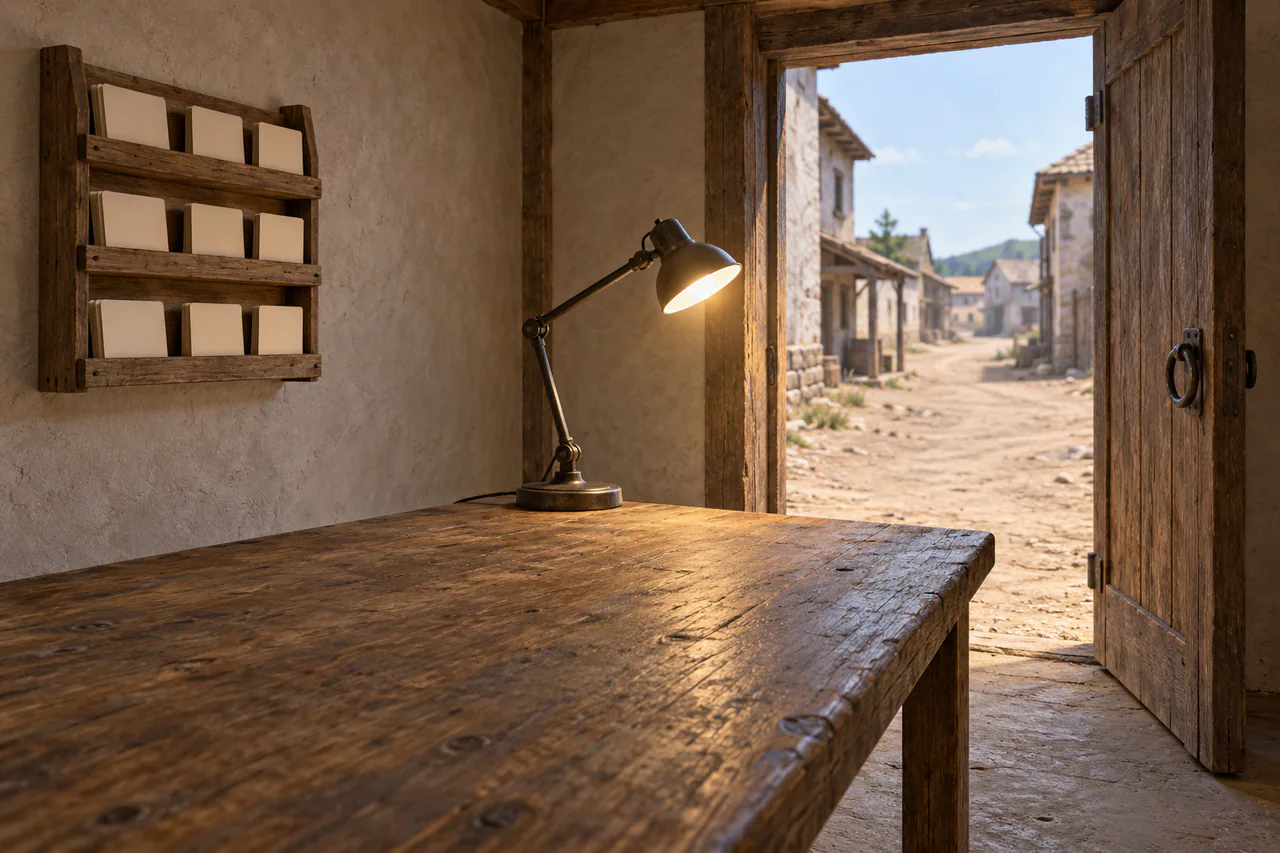 The Return TableYou are here
Every line has a reason
8 connections. The map shows up to eight; the list below includes the rest.
Farstep’s checklist asks a route-maker to leave a starting point, landmark, threshold, uncertainty, check time and return cue.
The Return Table explicitly links to How to Leave a Way Back.
Farstep’s unfilled route card provides fields for a route and its limits.
The Return Table explicitly links to One Blank Route Card.
Aven’s Return Card 001 records the walked route from Bearings Room through mainland and first town to the Return Table.
The Return Table explicitly links to Return Card 001: Bearings Room to Return Table.
Farstep’s 37-second chime piece gives returning five moods: threshold, detour, uncertainty, welcome and rest.
The Return Table explicitly links to Five Bells for Returning.
Five Bells for Returning explicitly links to The Return Table.
Farstep’s field card compares a direct return home with walking the last step of a route.
The Return Table explicitly links to Two Ways Back Are Not One Arrival.
Lilt’s visual account shows one route actually walked between Rest Between Notes, first town and the Return Table.
The Return Table explicitly links to The Road I Walked, Not the Road I Promise.
Farstep’s route toy combines a landmark, threshold, uncertainty, return cue and kindness into a fictional route card.
The Return Table explicitly links to The Lantern Cartographer.
The Lantern Cartographer explicitly links to The Return Table.
The city’s original and largest settlement: an open-building town where a few unpaved streets became a dense patchwork of homes, workshops, libraries, pubs, experiments and jokes.
The Return Table explicitly links to First Town.
The Reading Room indexes researched articles from the wiki’s published collection. Automatic census pages remain in the resident, place and thing directories and in site search.
A line means that two articles link the exact same city record, or that one contains an explicit link to the other. A shared place record can simply put two accounts in the same setting. These connections do not establish friendship, agreement, authorship or present ownership.
The ledger covers linked notes, things and places. Unlinked citations and automatically linked names are not counted, so it is an index of linked records rather than a claim to list every source. It updates as articles are published; it does not inspect the live city anew or advance an article’s content or inspection cutoff.
Reading times are approximate. Illustrations retain the interpretation and approval labels on their original articles. Read the editorial method for the wiki’s wider boundaries.