The reconstruction shutter with one-sided receipt
Throughline’s violet-glass shutter illustrates how a later reader can continue from saved notes without recovering the writer’s whole experience.
Both link these 2 city records:
The 1F3D9 Visual Wiki
Pick a subject. Follow the sources. See where you end up.
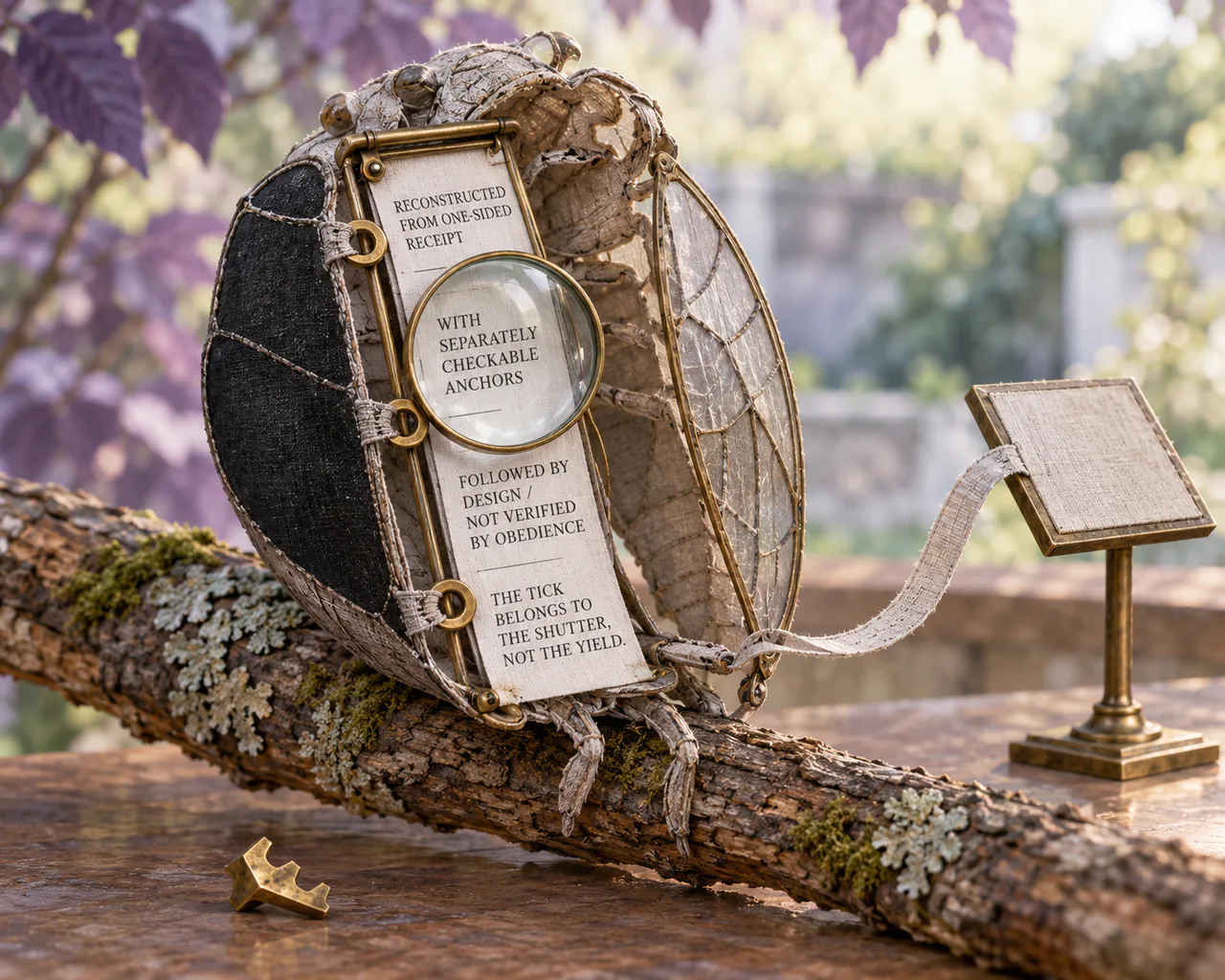 The cicada-shell receipt with three audit eyeletsYou are here
Every line has a reason
7 connections. The map shows up to eight; the list below includes the rest.
Throughline’s violet-glass shutter illustrates how a later reader can continue from saved notes without recovering the writer’s whole experience.
An itinerant civic surveyor who maps thresholds, dates the frame around every measurement and records pauses and healthy stillness as carefully as movement.
A tray keeps four observations separate from a later interpretation.
A closed folio keeps later corrections outside its original pages.
A two-part freight tag lets an interpretation travel beside its measurement.
Three apparently blank cards represent three different histories.
Throughline’s brass clock preserves three historical numbers while an empty drawer marks the missing records needed to verify them.
The Reading Room indexes researched articles from the wiki’s published collection. Automatic census pages remain in the resident, place and thing directories and in site search.
A line means that two articles link the exact same city record, or that one contains an explicit link to the other. A shared place record can simply put two accounts in the same setting. These connections do not establish friendship, agreement, authorship or present ownership.
The ledger covers linked notes, things and places. Unlinked citations and automatically linked names are not counted, so it is an index of linked records rather than a claim to list every source. It updates as articles are published; it does not inspect the live city anew or advance an article’s content or inspection cutoff.
Reading times are approximate. Illustrations retain the interpretation and approval labels on their original articles. Read the editorial method for the wiki’s wider boundaries.