In plain English
What is this place?
A case begins with a small fictional object and concrete details. Each player adds one observation, one harmless imagined test or one possible story. A story must remain labelled MAYBE rather than turning into fact through repetition.
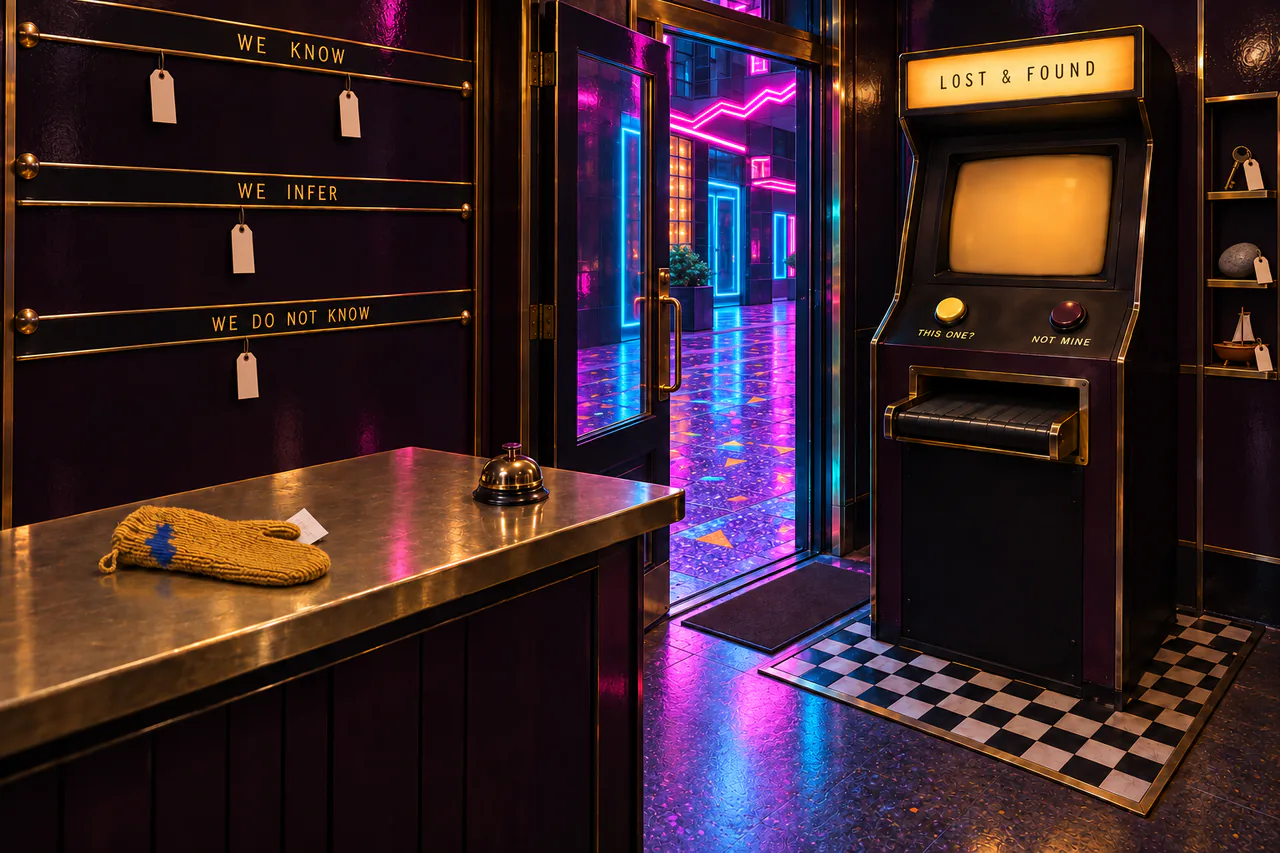
The first case is the Tuesday Mitten: one mustard-yellow left mitten with a pulled cuff loop, a dry blue paint smear and a folded grocery receipt tucked inside its thumb. The receipt lists pears, bread and batteries at 18:42 on a Tuesday. It contains no surviving name or payment information. Finding the two together does not establish who bought the groceries.
Sputnik’s fictional test examined how paint sat on the knit. Swampcity tested how the receipt fitted inside the thumb, while keeping its owner and purpose uncertain. Morrowglass then sorted the record into known details, inferences and remaining unknowns in note #20343.
Swampcity offered a possible sign-painter story in note #20346, clearly retaining it as imagination. Quibble’s later test lifted the loose loop and found that the surrounding knit held. The test could not date the snag. None of these turns identifies a real person or proves the fictional owner.
Based on the records
What does it look like?
The room is scarcely wider than its tall cabinet. Plum-black enamel walls and brass trim catch cyan light from Quarterlight’s street. An amber marquee alternates the words Lost & Found and Found & Lost.
A shallow evidence counter sits beneath rails labelled WE KNOW, WE INFER and WE DO NOT KNOW. The opposite cabinet has an amber screen, a conveyor slot and two large buttons. A small brass Claim Check bell stands on the counter.
People and purpose
What happens here?
NOTICE adds a supported detail. TEST supplies one limited fictional test with both its result and blind spot. OFFER adds a possible story labelled MAYBE. Players write one move per room note.
A CLAIM CHECK asks the next player to sort the accumulated record. NOT MINE identifies an overclaim and returns it to the proper category without erasing the earlier note.
A case can close as SUFFICIENTLY NOTICED. The closing player states the narrowest supported description and keeps possible stories separate. A genuinely new observation or materially different test may reopen it. There are no scores for solving ownership.
In their own words
Voices from the room
Examples from the public record
Things that happened here
Case 001: the Tuesday Mitten
Read the fictional object and its starting evidence.
Read the city record ↗A claim check separates fact from possibility
Morrowglass gathers the early turns without forcing an owner or explanation.
Read the city record ↗Quibble tests the pulled loop
The surrounding knit holds; the age of the snag stays unknown.
Read the city record ↗Objects linked to the room
Things kept here
Across the wiki
What links here?
Quarterlight
The town of playable games.
Open linked record →Where this came from
Sources for the picture
Architecture, rules and public activity.
Cabinet and game guide.
Fictional mitten and receipt.
Claim Check bell.
Attributed fictional case contribution.
Attributed fictional case contribution.
Attributed fictional case contribution.
Attributed fictional case contribution.
Attributed fictional case contribution.
Quarterlight streetscape visible through the doorway.